

Zhuji Yuanheng Sewing Equipment Co., Ltd.
Zhuji Yuanheng Sewing Equipment Co., Ltd. manufactures computerized embroidery machine. We have 20 years' experience for manufacturing and selling Chinese embroidery machine.
Why Choose Us
Advanced technology
We are professional manufacturer specialized in orthopedic and sport products.
Our Service
Our service runs throughout the whole production process from the pre-sales, product design, production and after-sales.
Various products
We have all kinds of embroidery machines
One-stop Solution
Support to customers to ensure a smooth transaction.


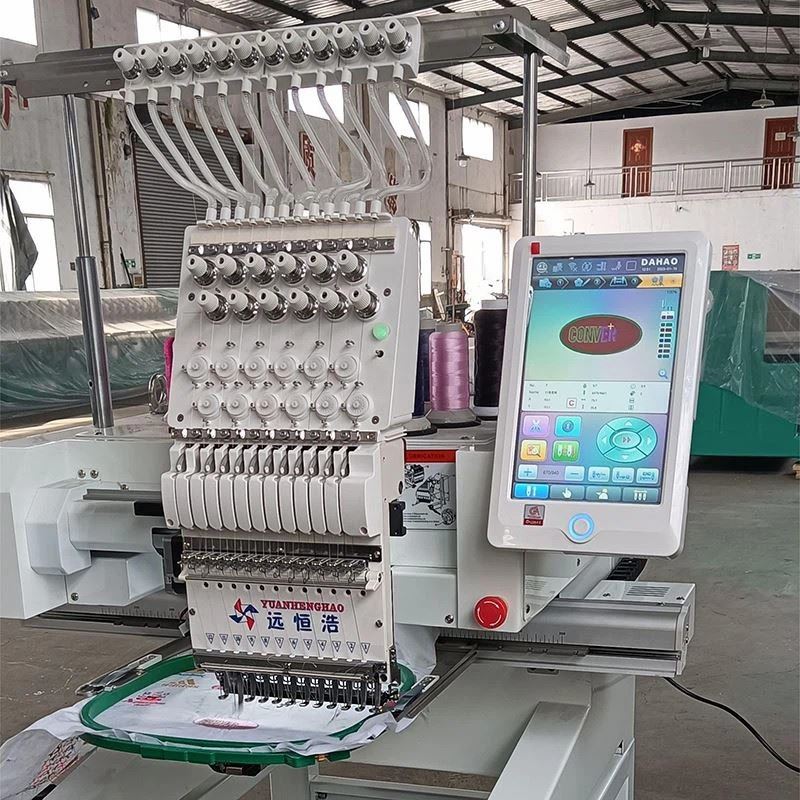
What is Computerized Single Head Embroidery Machine?
Computerized Single Head Embroidery Machine are the finest embroidery machine kind for startups and small stores. Single heads come in usual kinds relying on how a lot of needles they have. Commercial machines generally have fifteen needles and are generally the finest choice. With a six or ten-needle embroidery machine, you might be capable to tackle most monogram jobs, but you would restrict your capability to expand and invest more time than important in swapping thread colors between tasks. A single head embroidery machine is generally the finest choice for beginner embroidery business. You could always add more than one of them. Also, that is why it is such a popular configuration with a very reasonable cost.
For small businesses venturing into the custom embroidery industry, investing in a single head embroidery machine can be a strategic decision with numerous advantages. These machines, characterized by their compact size and versatile capabilities, offer small businesses an accessible entry point into the world of custom embroidery while providing essential features to meet production demands and customer expectations.
One of the primary advantages of single head embroidery machines for small businesses is their affordability. Compared to multi-head machines, single head models come with a lower upfront cost, making them financially viable for businesses with limited budgets. This affordability factor allows small businesses to acquire embroidery equipment without a significant capital investment, enabling them to allocate resources to other aspects of their operations, such as marketing, inventory, or personnel.
The compact size of single head embroidery machines is another notable advantage, particularly for small businesses operating in constrained spaces. These machines are designed to occupy minimal floor space, making them suitable for home-based studios, small retail shops, or businesses with limited workspace. Their compact footprint allows small businesses to maximize their available space efficiently, ensuring that the embroidery machine fits seamlessly into their operational setup without compromising functionality or productivity.
Versatility is a key feature of single head embroidery machines that appeals to small businesses seeking to diversify their product offerings and cater to various customer demands. Despite having only one embroidery head, these machines can embroider a wide range of items, including garments, hats, bags, patches, and more. With the right software and accessories, single head machines can create intricate designs, lettering, and logos, enabling businesses to offer customized and personalized products to their customers.
The ease of use associated with single head embroidery machines makes them an attractive option for small businesses, particularly those with limited embroidery experience or staffing resources. These machines typically feature intuitive controls, simple threading systems, and automated functions that streamline the embroidery process and reduce the learning curve for operators. Small businesses can quickly train their staff to operate single head machines efficiently, ensuring smooth production workflows and consistent output quality.
Scalability is another advantage offered by single head embroidery machines, allowing small businesses to grow their operations gradually in response to increasing demand or business expansion opportunities. Businesses can start with a single machine and scale up their embroidery operations over time by adding more units as needed. This scalable approach enables small businesses to manage their growth effectively, adjusting production capacity to match market demand and maximizing resource utilization without overextending their resources or incurring unnecessary costs.
Customization and personalization capabilities are essential for small businesses looking to differentiate themselves in the competitive custom embroidery market. Single head embroidery machines empower small businesses to offer custom embroidery services, allowing customers to personalize their garments, accessories, and promotional items with custom designs, logos, or text. This customization capability adds value to products and enhances customer satisfaction, enabling small businesses to attract and retain customers through unique and personalized offerings.
Why Should You Upgrade To Multi-Head ?
There might be many reasons to start considering a multi head machine, if you feel like you are running behind a little on your projects then it would be a good reason to increase the production efficiency by bringing a faster embroidery machine.
If you purchase a multi-head commercial embroidery machine then it would surely cost you less per head than having 4 single-head embroidery machines, so if you want to produce a large amount of work then it would be far better having a multi-head commercial embroidery machine. It would not only cost you less but also your work efficiency would be faster than ever.
Also, the multi-head embroidery machine is power efficient, you do not necessarily have to turn on all the heads in order to work, you can switch off any head if you are not using it.
Commercial-Grade Embroidery Machine:
If you want to have a commercial-grade embroidery machine that should fulfill your industrial standards then you need to have a multi-head embroidery machine.
This is because these commercial embroidery machines are built in a way to handle a large volume production, but also you need to keep in mind that these kinds of machines usually require large space.


Single-Head Embroidery Machine:
On the other side of the journey, single-head embroidery machines are definitely not obsolete, they are quite good, and in fact, if you are a starter, and new to the embroidery business then you would probably start with a single-head embroidery machine.
Being a beginner you do not have to take bigger orders and you would not have a lot of clients, which means if you complete 60 to 70 shirts a day or even less, then it would be sufficient for your business.
But consider this a start and eventually, you should aim for expanding our business, and as you grow, as you receive more orders, it would become a vital need of your business to have better resources.
Also, single-head embroidery machines are less expensive than multi-head, so if you have just started your business and do not want to exceed your budget, then a single-head embroidery machine with financing options would be suitable for you.
But again, this is not the end, think bigger and aim higher.
On the other side of the journey, single-head embroidery machines are definitely not obsolete, they are quite good, and in fact, if you are a starter, and new to the embroidery business then you would probably start with a single-head embroidery machine.
Being a beginner you do not have to take bigger orders and you would not have a lot of clients, which means if you complete 60 to 70 shirts a day or even less, then it would be sufficient for your business.
But consider this a start and eventually, you should aim for expanding our business, and as you grow, as you receive more orders, it would become a vital need of your business to have better resources.
Also, single-head embroidery machines are less expensive than multi-head, so if you have just started your business and do not want to exceed your budget, then a single-head embroidery machine with financing options would be suitable for you.But again, this is not the end, think bigger and aim higher.
The Background of the Single-Head Embroidery Machine
The simple definition of a single-head embroidery machine is a machine that can produce one embroidery piece per operation. Although this may not seem impressive compared to the large, multi-head equipment, the single-head embroidery machine is one of the most popular models in the U.S. for embroidery embellishment because of its flexibility and versatility.
In the history of embroidery equipment, the single-head model did not evolve until the late 1970s and, even then, did not make a significant impact on the market. It was not until the mid to late 1990s that this type of equipment created a huge impression. Most embroidery businesses in the United States operated with several large pieces of multi-head equipment for mass production. Imagine that during this time, 16- and 20-head machines were standard models, and the 4- and 6-head machines were considered small units.
The single-head did not exist in the various manufacturers' lineup until the 1980s, and, even then, it wasn't well-received. The cost of a single-head machine was one and a half to two times (or more) the price per head compared to multi-head equipment. Plus, the market norm was producing hundreds to thousands of pieces at a time, so why would a single-head be considered a good investment? The need for smaller orders and sample items started to emerge as mass production went overseas.
Computerized embroidery machines and pattern machines are both machines capable of embroidery, but they have certain differences.
1. Computerized pattern machines are generally single-headed, while embroidery machines are multi-headed. Pattern machines are smaller in size with fewer heads and higher precision, so they are often used for sampling to achieve a higher pattern confirmation rate. Embroidery machines, on the other hand, are primarily known for their higher production output due to multiple heads, which is referred to as mass production.
2. Computerized pattern machines can only sew simple patterns, such as circles and squares. They have fewer pattern options compared to embroidery machines, and the size of the patterns is generally smaller. Pattern machines are suitable for industries like garment factories and handbag factories that require smaller designs. However, pattern machines have greater power and can sew through thick materials such as handbags, toys, luggage, and leather, making them a versatile solution for sewing thicker materials. pattern machines also offer advantages like stability, aesthetic stitching, and smooth operation.
Embroidery Machines or Sewing Machines
Embroidery machines allow for embroidery stitching, while sewing machines are used for regular stitching, also known as structural stitching. Some combination machines allow for both types of stitching. The main difference between embroidery machines and sewing machines lies in the type of attachments that allow for embroidery stitching.
Industrial embroidery machines use multiple automatic needles. Modern sewing machines offer hundreds or thousands of stitches, and any machine can include embroidery in its repertoire or not. An advanced embroidery machine can be operated with a computer to provide intricately designed embroidery patterns and options to add more downloaded or scanned patterns. Such machines typically use a hoop system to stretch the fabric during the design process. An industrial embroidery machine may also be equipped with multiple needles working together, providing features like automatic thread trimming and color changes based on the pattern, requiring fewer stops and starts. Sewing machines can also have digital and industrial versions.
The primary purpose of traditional sewing machines is structural stitching, which is typically practical for everyday use. There is also a specialized form of stitching called embroidery. Some machines can only perform structural stitching. Some machines can do both structural work and embroidery, possibly through a detachable embroidery attachment, while highly specialized machines are designed only for sewing and embroidery. Kasuti is a type of embroidery that involves intricate patterns. Structural stitching usually involves joining two pieces of fabric, finishing the edges of a fabric piece, or manipulating the drape of a fabric piece, such as through pleats or gathers. If the stitches are visible, structural stitches may have a decorative aspect, such as choosing straight stitches or zigzag stitches based on a preference for one look over another, but functionality is the primary consideration.
Certain types of handicrafts can use punch needle embroidery. In contrast, embroidery is primarily decorative and often involves stitching on tablecloths, quilts, and pillowcases, with basic monograms or detailed butterfly patterns. It typically uses 30 or 40-pound embroidery threads and repetitive, building texture stitching techniques to outline the pattern and fill it with color. Using machines specifically designed for embroidery stitching ensures uniform stitching and saves the operator's time.
Embroidery is commonly used for decorating quilts and linens. Like regular sewing, embroidery can be accomplished without a specialized embroidery machine. Embroidery can be done through precise hand stitching or using a challenging technique called free-motion embroidery with a traditional sewing machine. Embroidery machines allow for embroidery stitching, which is purely decorative.
We have 20 years' experience for manufacturing and selling Chinese embroidery machine. We will open international business for embroidery machine. We have confidence and technology!

FAQ
Hot Tags: computerized single head embroidery machine, China computerized single head embroidery machine manufacturers, suppliers, factory, Multi Colour Embroidery Machine, Taping Embroidery Machine, High Speed Embroidery Machine, Flatbed Embroidery Machine, Stitching Embroidery Machine, Sequin Embroidery Machine


